Showing posts with label phases of the moon. Show all posts

Monday, June 12, 2023

Patterns of People in the Phases V

 Artists' Work as their Soul's Essence

 (This follows from Patterns of People in the Phases Part I, Part II, Part III, Part IV.) 


Central section of the southern side of the Frieze of Parnassus on the Albert Memorial, London (the poets and musicians),
by George Gilbert Scott (1864–72).


To return to the panoply of poets and thinkers, my observations about the preponderance of artists and the way that they are viewed are far from original. Helen Vendler, for instance, makes very similar comments in the book of her thesis, Yeats’s “Vision” and the Later Plays from 1963, explaining Yeats’s “scheme of literary history,” and noting how the different phases focus on the poets’ aesthetics. 

About two thirds of all the examples Yeats chooses to give are literary men; of these, about two thirds are poets. The twenty-eight phases become virtually, in the course of the book, a scheme of literary history, bizarre perhaps, but literary history all the same—and most especially, poetic literary history.

 Helen Vendler, Yeats’s “Vision” and the Later Plays, 29–30

Hazard Adams says much the same in The Book of Yeats’s Vision from 1995. He observes that Yeats “sees the writers in or as their work,” and this gives some an indication of what Yeats identifies in each person within the wheel. 

Of the forty-eight “examples” specifically cited, thirty-one are what we call imaginative writers and one is a painter; only four (Victoria, Parnell, Napoleon, and Socrates) are not writers of some kind. Yeats sees the writers in or as their work, and as metonyms they are absorbed into fiction much as he is absorbed into the fiction of A Vision.

Hazard Adams, The Book of Yeats’s Vision, 88

And it is not just professional self-regard that makes writers and poets predominate, nor is it laziness that equates artists with their work. Yeats regards artists—at their best, at least—as giving something of their soul's own essence in their work, thus making them clearer and more explicit exemplars of the soul's bias and ways of being. The lineaments of Will, Mask, Creative Mind, and Body of Fate can be traced more clearly because the artists have transferred them into what Yeats terms "phantasmagoria"—the eerie images cast by magic lanterns in a form of proto-cinema—implying that they project their own life in transmuted form artistically.

A poet writes always of his personal life, in his finest work out of its tragedies, whatever it be, remorse, lost love or mere loneliness; he never speaks directly as to someone at the breakfast table, there is always a phantasmagoria. Dante and Milton had mythologies, Shakespeare the characters of English history, of traditional romance; even when the poet seems most himself, when he is Raleigh and gives potentates the lie, or Shelley ‘a nerve o’er which do creep the else unfelt oppressions of mankind’, or Byron when ‘the heart wears out the breast as the sword wears out the sheath’, he is never the bundle of accident and incoherence that sits down to breakfast; he has been re-born as an idea, something intended, complete. A novelist might describe his accidence, his incoherence, he must not, he is more type than man, more passion than type. He is Lear, Romeo, Oedipus, Tiresias; he has stepped out of a play and even the woman he loves is Rosalind, Cleopatra, never The Dark Lady. He is part of his own phantasmagoria and we adore him because nature has grown intelligible, and by so doing a part of our creative power.

Essays & Introductions 509, cf. CW5 204

What the assigned phase of A Vision's pageant is intended to indicate is not the person we might meet in the street but a kind of essence, not “the bundle of accident and incoherence that sits down to breakfast” but the self “re-born as an idea, something intended, complete.” In their work, the poets are “more type than man, more passion than type,” and “nature has grown intelligible.” And this, in part, is the reason why the poets—“in or as their work”—dominate the pantheon of the phases—there is a clarity and intelligibility that is separate from the accidents of personality, opinion, and contingency.

The unique quality of the poet, even over other artists perhaps—the novelist, for instance, may “describe his accidence, his incoherence”—is this expression of something fundamental. As he explained to Olivia Shakespear: “You can define soul as ‘that which has value in itself’ or you can say of it ‘is that which we can only know through analogies’ ” (July [1934], CL InteLex 6074, cf. Letters (Wade) 825). And the soul’s “characteristic act” is being in time or “temporal existence”:

Even though we may think temporal existence illusionary it cannot be capricious; it is ... the characteristic act of the soul and must reflect the soul’s coherence.... We may come to think that nothing exists but a stream of souls, that all knowledge is biography, and . . . that every soul is unique.

Introduction to The Resurrection, Variorum Plays 934–35; Explorations 396–97

Poets may reveal this soul more effectively through their writing, but every person has a soul. 

A poet is by the very nature of things a man who lives with entire sincerity, or rather, the better his poetry, the more sincere his life. His life is an experiment in living.... it is no little thing to achieve anything in any art, to stand along perhaps for many years.... to give one’s own life as well as one’s words (which are so much nearer to one’s soul) to the criticism of the world.

“The Friends of My Youth” (lecture draft, 1910), Yeats and the Theatre, 74

This is part of what Yeats had told Moina Mathers he was looking for in his involvement with the Hermetic Order of the Golden Dawn in the dedicatory introductions to A Vision A in 1925:

I wished for a system of thought that would leave my imagination free to create as it chose and yet make all that it created, or could create, part of the one history, and that the soul's. . . . What I have found indeed is nothing new, for I will show presently that Swedenborg and Blake and many before them knew that all things had their gyres; but Swedenborg and Blake preferred to explain them figuratively, and so I am the first to substitute for Biblical or mythological figures, historical movements and actual men and women. 

(AVA xi–xii, CW13 liv–lv)

The other representatives of the phases may not have the opportunity to project so fully or clearly as the poets, but also in their own ways are regarded as expressing their essence in their work and life, not in every accident and detail, but in an overriding quality or mood that, for instance, Yeats considers to make a Shakespeare like a Napoleon like a Balzac. We have no work by which to judge a "mute inglorious Milton" and lack of deeds leaves a "village-Hampden" unknown, as well as a "Cromwell guiltless of his country's blood," as Thomas Gray saw in his "Elegy in a Country Churchyard." The selected names have something that expresses their essence clearly and brings them to prominence, and may therefore provide us with a mnemonic figure for their phase.

1: New Moon; 2: Bacchus; 3: a hamadryad; 4: Chiron; 5: Byron's Giaour; 6: Whitman; 7: Dumas; 8: Prince Myshkin; 9: Lewis; 10: Parnell;
11: Spinoza; 12: Nietzsche; 13: Beardsley; 14: Keats; 15: Full Moon; 16: Blake; 17: Shelley; 18: Goethe; 19: Byron; 20: Balzac;
21: Shaw; 22: Darwin; 23: Rembrandt; 24: Victoria; 25: Luther; 26: Il Gobbo (Hunchback/Hermit); 27: Pascal; 28: Il Matto (Fool).


Monday, June 5, 2023

Patterns of People in the Phases IV

 Creating through Opposition

 (This follows from Patterns of People in the Phases Part I, Part II, Part III.)

Creating from opposition

The nature of artistic creation is, according to the Yeatses' system, affected by the operation of the Faculties, especially the Mask. In terms of the artists' lives more broadly, it is Daimons (or Gatekeepers as they are called in The Trembling of the Veil) that engineer the circumstances for creativity.

[The Daimons] contrived Dante’s banishment, and snatched away his Beatrice, and thrust Villon into the arms of harlots, and sent him to gather cronies at the foot of the gallows, that Dante and Villon might through passion become conjoint to their buried selves, turn all to Mask and Image, and so be phantoms in their own eyes. In great lesser writers like Landor and like Keats we are shown that Image and that Mask as something set apart; Andromeda and her Perseus—though not the sea-dragon—but in a few in whom we recognize supreme masters of tragedy, the whole contest is brought into the circle of their beauty. (Au 273, CW3 217)


"Andromeda and her Perseus," without and with sea-dragon...
Edward Burne-Jones, Perseus and Andromeda, 1876. Art Gallery of South Australia, Adelaide.

Yeats is expressing in semi-public terms for the autobiography the creation of internal Mask and its embodiment as Image in poetry: Andromeda represents the Image of desire, while Perseus is the Mask adopted by the poet. The dragon represents the dark side of life, the recognition of the negative poles, the Body of Fate in terms of the Faculties.

Thus we find Landor’s shepherds and Shelley’s wanderers at Phase 3 opposite the poets’ phase, Byron’s Don Juan and Giaour opposite his phase 19, and Browning’s old hunter talking with gods or king of long ago, almost opposite. For Yeats, the artists need the polar opposite represented by the Mask whether it is the Image, the object of love—Andromeda—or the projected self, the lover—Perseus: for Shelley, Epipsychidion or Venus Urania and Alastor or Athanase. For Yeats, the greatest artists manage to fuse them into something more complete, the circle of beauty. Furthermore they embrace the opposite impulse represented especially by the destructive Body of Fate, the sea-dragon, the recognition that conflict is inherent in the world, which he calls, idiosyncratically, the Vision of Evil. 

[Dante and Villon] The two halves of their nature are so completely joined that they seem to labour for their objects, and yet to desire whatever happens, being at the same instant predestinate and free, creation's very self.... Had not Dante and Villon understood that their fate wrecked what life could not rebuild, had they lacked their Vision of Evil, had they cherished any species of optimism, they could but have found a false beauty, or some momentary instinctive beauty, and suffered no change at all, or but changed as do the wild creatures, or from Devil well to Devil sick, and so round the clock. (Au 273, CW3 217)

Opposition in creation

Yeats also treats his fellow poets as representatives of different attitudes to life, including religion (something he would later do with his two children). There is a draft for the revised version of A Vision in Rapallo Notebook B, where Yeats struggles to express something of this. He talks of two approaches to Christianity, one of which is lyric and associated with Shelley and Keats, while the other is tragic and Dantean.  

I myself seek a symbol that can thrust Christianity back into the crises where it arose, and there display it not as an abstract ideal but united to its opposite, or thrust it forward into the crisis where the actors must change robes & the defeated Tincture triumph in its turn. An abstract ideal is lyrical.
                     VI
An ideal separated from its opposite is lyrical acquires a is lyrical; has a phantastic imobility like that of the Greek figures in Keats Ode & palls upon us po, has a phantastic imobility like that of the gr figures Keats saw upon the Urn & therefore xxx palls upon us, the exceptional moment past; whereas but an idea united to its opposite is tragic & stays always like the poetry of Dante
                    VII
and like the poetry of Dante needs no exceptional moment & always stays like the poetry of Dante. An ideal separated from its opposite is lyrical, & its phantastic imobility palls upon us, but an ideal united to its opposite is tragic & stays always like the poetry of Dante. I am tired of Shellean Christianity.

Rapallo Notebook B, NLI 13,579, [53r–54r]

He appears to reject the lyric form as abstract in favour of a more dramatic approach where the opposing pole brings in conflict. He associates the lyric form with “an ideal separated from its opposite,” something that A Vision deplores, as it is said to “consume itself away” (AVA 134, one of those phrases that Yeats left from the automatic script, partly our of respect for the form of words, and partly uncertain of the full meaning). 

He even goes so far as to compare the lyric mode to “a phantastic immobility like that of the Greek figures in Keats’s Ode” on a Grecian Urn, whereas “an ideal united to its opposite is tragic & stays always like the poetry of Dante.” He closes by saying that he is “tired of Shellean Christianity”—that is, not that Shelley was Christian but the Shelley of the "Hymn to Intellectual Beauty" represents an approach to Christianity as an abstract, unmixed ideal. 

Yeats is writing about religion, but in the aesthetic terms he knows, and there is some implicit belittling of the lyric mode. The later, more succinct redraft in Rapallo A appears to view Shelley’s work as a “song in the air” contrasted with the conflagration of the phoenix and its rebirth. 

An ideal separated from its opposite is lyrical & its fantastic immobility palls upon us but an ideal united to its opposite is tragic & stays always like the poetry of Dante. I am tired of Shellean Christianity—I prefer to any song in the air a Phoenix, that rises twelve times from a body twelve times consumed to ashes.*

Rapallo Notebook A, NLI 13,578, [8r], page numbered 5

Opposition within the creator

Though Shelley and Dante are both representatives of the same Phase 17 as himself, they here represent the two parts of Yeats's creative character, lyric and dramatic. This creation of opposites needs both the polar opposite represented by the Mask, which brings the lyric impulse and aesthetic beauty, but also the opposite impulse represented by Creative Mind, bringing the construction of conceit and universals, and especially Body of Fate, which rounds with the tragic aspect.

It seems all the stranger that Yeats says that the "phantastic imoblity" of the "Ode to a Grecian Urn" "palls upon us," because he opens that same notebook with a description of Rapallo and its bay, comparing the town precisely to the scenes depicted on Keats’s Urn with tender approval. Yet it indicates the tension that Yeats felt and the criticisms directed towards his own practice, that he would express in poems such as “Vacillation” and “The Circus Animals’ Desertion.” However complex it may be, a lyric poem of necessity focuses rather than drawing all in, but many critics have observed how Yeats's poetry resists immobility, often using questions to open the end of poem up, to invite the opposite and avoid any impression of neat conclusion. 


—————————————————

* Yeats complicates the image of the phoenix reborn in fire by bringing in another meaning that he was playing with at this time, where he referred to the twelve "incarnations of Buddha" or avatars of the divine as "twelve Phoenixes." These had been called "Masters" in the automatic script, "Fountains" in AVA, and are not really dealt with in AVB. For this and the material cited above, see my essay "Rapallo Notebooks A and B" in International Yeats Studies 6.  

Thursday, May 25, 2023

Patterns of People in the Phases III

Poets, dramatists, and novelists

 (This follows from Patterns of People in the Phases Part I and Part II.)

Yeats's list of people in the phases is heavily biased towards European male writers and artists, partly because of the bias of his times but also because he is seeking to locate himself within the framework of tradition as a European poet writing in English. 

If we focus on the poets, most of them also write in English, apart from a few figures such as Homer, Virgil, Horace, Villon, the great landmarks of past European literature, as well as more recent figures and influences such as Baudelaire and Verlaine. And apart from Walt Whitman and Ezra Pound, most of the poets are British or Irish.  

Those in red and orange here write in English—those in red are English, and the bright red ones are the leading Romantics. There is a strong group of aesthetes in the two or three phases before the Full Moon, including the poets of the Tragic Generation. By placing Dowson and Beardsley at 13 along with Baudelaire and Verlaine, the arrangement underlines the French influence; with Lionel Johnson at 14, WBY is placed on the other side of the Full Moon from almost all the poets of the Rhymers’ Club. (Arthur Symons was uncertainly placed at 18 or later, more like Yeats and Wilde, perhaps.) Interestingly, WBY is more aligned with the Pre-Raphaelites and the Romantics. I include Rossetti here as a poet, and he was moved from 14 to 17, along with Burne-Jones, and William Morris who is indicated to be from Phase 17 or 18. (Michelangelo is also included here for his poetry, as is Walter Raleigh, despite winning fame for other achievements.) 

Of the Romantics, Keats and Wordsworth make slightly strange bedfellows in Phase 14, but their placement before the Full Moon in the second quarter suggests that, for them, emotion and aesthetic experience are more important than intellect and scheme in their work. After the Full Moon the imagination becomes more intellectual and in the later part of the third quarter it is increasingly more dramatic in its expression. At Phase 16, Blake the myth-maker creates a world that has an independent existence, while at Phase 17, Shelley’s myths are less all-encompassing and more dramatically expressed, including works such as The Cenci and Prometheus Unbound. At Phase 19 comes Byron, who is the most theatrical in his projections of persona and thought of all the Romantics from Childe Harold to Manfred and Cain. Byron is made the kin of Browning, the poet of dramatic monologues, and Wilde, a successful playwright, while the myriad-minded creators Shakespeare and Chaucer are placed at Phase 20, a peak of dramatic power—as is Balzac—before the more didactic voices of poets such as Milton at Phase 21. 

The surprising absence is Coleridge. If Shelley and Blake dominated Yeats's youthful imagination, by the 1920s Yeats probably makes more frequent reference to Coleridge's works in poetry and prose, including his collected "Table Talk." If I feel tempted to hazard putting Coleridge at Phase 18, it is not just to fill the empty phase, but for the importance of philosophical thought in Coleridge's later work and what could be seen as a form of the "emotional philosophy" of this phase.

Moving to the novelists and dramatists, there is some overlap, but the dramatists are almost entirely confined to an arc of phases between 18 and 24, and it is perhaps doubtful that Goethe would be counted a dramatist foremost. Shelley and Yeats (Phase 17) wrote plays too, and it is implied that Maeterlinck would be Phase 17 or close, because of his heroines at Phase 3.

The novelists are rather more widely spread, thoug the main group occurs close to Phase 22, where antithetical creativity is still strong enough, but primary recognition of human realities channels this creativity towards the more realistic forms of the novel. The proto-novelists who are perhaps closer to romance, such as Rabelais and Cervantes, are placed at the mythopoeic Phase 16, along with James Stephens, tellers of tales and creators of worlds, and WBY’s tales may well fall under a similar influence. The other novelists in the earlier phases of the wheel are difficult to classify—does the placement of Defoe at Phase 3 portray him more as a reporter of the Plague Year and, perhaps by extension Robinson Crusoe and Moll Flanders? Alexandre Dumas is seen as delighting in history, adventure, and action, themes of the wheel's first quarter. But Tolstoy seems out of place, even if one takes into account that he is elsewhere seen as being one of the most "advanced" souls considered, in his ninth cycle of incarnations (only Montaigne and Socrates are more advanced). The polemic of Wyndham Lewis's fiction is possibly less important than his painting, as Yeats placed Cubists at Phase 9.

In the panoply of worthies he assembles, Yeats is effectively reckoning his own position in terms of both his predecessors in the traditions of English literature and of the universal poets of European culture. He sought to define himself with and against his fellow inmates at Phase 17, particularly Shelley and Dante, but also Landor, Blake at 16, Keats at 14, and Villon at 18. As fellow a Daimonic man, Shelley is treasured for his visionary poetry and criticized for his propagandizing—Yeats seems to see him both as a model and a warning about political involvement. In contrast, Dante is the paragon of the poet, tragic and creating a new world out of his tragedy, and in his case, his partisanship is seen as a necessary spur to exile and loss, but Dante comes from an age which had some Unity of Culture, when such things were clearer and, implicitly, a life and genius such as his were no longer attainable in the twentieth century. Neither Landor nor Shelley was unable to attain true Unity of Being, because they lived in a broken age, according to Yeats, which implies that he did not think it truly possible for himself either.


Friday, February 11, 2022

Patterns of People in the Phases II

(This follows on from the first post, which is here)

Assigning the phases

At least at the initial stages, the assignment of people to their phases was done by George Yeats or the voices speaking through her hand. Yeats appears to have accepted what his wife wrote to a large extent—there are tweaks, questionings, and changes, but in general he sought to understand what she gave him in its own terms.

Leaves from WBY's question notebook (L) and the automatic replies in a separate notebook (R), from 21 December 1917 (see YVP1 168–69). The numbering is slightly out here.
Question 44 (in the lower half of the page) asks "How late can one find a measure of artistic beauty" and the answer (at the top of the answer page) is numbered 45: "till 24".
Q45: "How does literary style differ before and after beauty", referring to Phase 15, and the answer is 46: "Before beauty style is created after beauty it is inherent not sought after tennyson is at twelve Goethe at 18 Dante at 17 Wordsworth at 14".


As with the rest of the script, the names were assigned in the to and fro of the dialogue between the couple, and most of them appeared during relatively few sessions early in the automatic writing sessions in December 1917 and January 1918. So on the pages shown above, from 21 December 1917, just two months after the script had started, we have the guide called Leaf assigning—any prompting—Tennyson to Phase 12, Goethe to 18, Dante to 17, and Wordsworth to 14 in order to illustrate a question about literary style. Then Rossetti is assigned to 14 and Browning to 19 in response to WBY’s questions.

List of phase attributions, filed with the AS of 2 June 1918 (see Yeats's "Vision" Papers, vol. 1, 549n5, The Making of Yeats's 'A Vision', vol. 2, 418, and A Reader's Guide to Yeats's 'A Vision' 303–8). The zodiac signs or numbers in parentheses refer to the people's "cycle"—how often they had already passed around the circle of phases.


More than a few of these attributions were later changed so that, despite the communicators' input, the Yeatses eventually put Keats at Phase 14 rather than Phase 12, closer to the Full Moon or Beauty but no longer the phase of the hero. Tennyson was also moved from 12 to 14. These were brought together in a list in 1918, only some of which were included in A Vision. (Not all of the names in A Vision are on this early list, but most of them are.) Excluding some fictional characters and categories there are about a hundred names in total.


In the amplified Wheel that follows, the inner names here are those that were not included in A Vision. The earlier phases are far fuller, while the antithetical phases are really just "more of the same", just adding more names and data points to the sample.

The Great Wheel including most of the names from the 1918 lists and A Vision.

Though the panoply is a little overwhelming at first, it also has some of the fascination of Judy Chicago's The Dinner Party (1974–79) or of Simon Patterson's The Great Bear (1992)—who is chosen? what are the connections? how do they relate?


Judy Chicago, The Dinner Party


Simon Patterson, The Great Bear


Tuesday, January 4, 2022

Patterns of People in the Phases I

[This is the first of a series of posts about the phases assigned to people in A Vision and the automatic script, some of them drawing on a presentation I gave to the International Yeats Society at the York conference in December 2021.]

What's Your Moon Phase?

Even those with only a cursory knowledge of A Vision, or perhaps even only the poem “The Phases of the Moon”, know that Yeats proposes a Great Wheel patterned on the phases of the moon, and that he assigns all human beings to one of the phases. 

Though there are 28 phases, only 26 types of humanity are possible, as "there's no human life at the full or the dark" ("The Phases of the Moon"). It looks a little like astrology or any form of typing, with a spectrum of temperaments where the ends join, like in a colour wheel. It is recognizable as analogous to 12 Zodiac signs or maybe 16 Myers-Briggs combinations, and it is certainly one of the parts of A Vision that most people remember

The labelling, however, doesn't use memorable symbols. Each phase is assigned not an archetypal emblem but a vaguely suggestive title—such as “Assertion of Individuality,” “The Emotional Man,” or “The Saint”—and, in most cases, Yeats includes an irregular assortment of the people who fall under this phase. 

In the Dedication to the 1925 edition of A Vision, Yeats claims that his predecessors like

Swedenborg and Blake and many before them knew that all things had their gyres; but Swedenborg and Blake preferred to explain them figuratively, and so I am the first to substitute for Biblical or mythological figures, historical movements and actual men and women.

It is not immediately clear what the names given share. Most would be hard-pressed to see the similarities between Napoleon and Shakespeare at Phase 20, though Balzac’s kinship to either might be a little easier to discern. George Russell, Æ, asked himself whether it was

insight or impishness which made [Yeats] link Bernard Shaw, H. G. Wells and George Moore as typical men of the twenty-first phase, or what old lady did he discover in Mr. Galsworthy to make him unite that novelist with Queen Victoria?

Russell was also

a little uncomfortable with some of [his] fellow-prisoners in phase twenty-five. I welcome George Herbert, but am startled to find myself along with Calvin, Luther and Cardinal Newman, as no doubt the last three would be incredulous of their own affinities to associate pilgrim souls.

Like Chaucer’s Canterbury pilgrims, the procession of souls embraces a gamut of types, but unlike Chaucer’s riders the range of professions and walks of life is considerably less varied. There is a heavy preponderance of literary figures in the pageant that Yeats unfolds, and the poets dominate.  

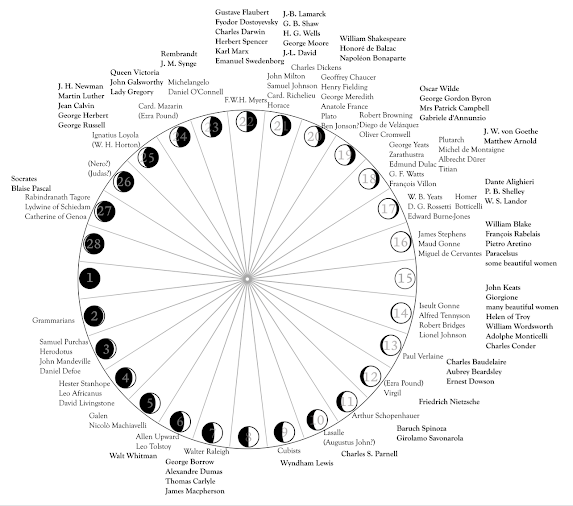
The Wheel of the Phases with the names assigned in A Vision
The people assigned to the phases in A Vision (fictional characters excluded)


Patterns of phases

Arranged on the Wheel, the names are a little crowded and not easily readable, but doing so clearly conveys the imbalances in the examples. The primary half of the Wheel (on the left-hand side here, centred on the New Moon at Phase 1) has some very empty spaces, particularly in Phases 2 to 5, while the antithetical half (on the right-hand side here, centred on the Full Moon at Phase 15) is far fuller. Even the antithetical half is more thinly populated in its early phases (9, 10, 11, 12), while the "early" phases of the primary (23, 24, 25) contain more names. Thus, the phases from 13 to 25 effectively account for the majority of the examples.

Some broad patterns emerge fairly quickly. The antithetical half is home to most of the creative artists: only two poets are placed outside the antithetical half, Walt Whitman and George Herbert, though James Macpherson, the "translator" of the Ossian poems, should probably also be added. 

Of the poets, the Romantics are distributed through the more antithetical phases, with Keats and Wordsworth at Phase 14, Blake at Phase 16, Shelley at Phase 17, and Byron at Phase 19. (Strangely Coleridge is not included, though it is likely he would take Phase 18 along with the more philosophically minded Goethe.) 

Political scientists such as Marx and Spencer are both placed at Phase 22, while evolutionary theorists Lamarck and Darwin are placed at 21 and 22, with Darwin in the more objective of the two. 

Church reformers of various stripes are found at 25, with the iconoclast Savonarola directly opposite at 11, along with Spinoza whose philosophy seemed atheist to his contemporaries, while Nietzsche who proclaimed the death of god follows at Phase 12.

Interestingly three of Yeats's closest collaborators are placed in three consecutive primary phases: John Millington Synge at Phase 23, Lady Gregory at Phase 24, and George Russell (AE) at Phase 25. 

I'll look at aspects of these groups in a little more detail in following posts, including some of the names that appear in the drafts but not in published version.


Saturday, December 1, 2018

Astrology of A Vision III: Six Attempts at an Astrological Reading

Marilyn Busteed, Richard Tiffany, and Dorothy Wergin were the pioneers of taking A Vision astrologically (in print, at least) and there is an exploratory, tentative tone to the work, characterized by the suggestion of three different methods to allot the phases. They offer equal "lunar" phases, unequal "solar" phases, and symmetrical, centred "lunar" phases.
 "There are 28 phases to equal the average number of days in the lunar month. 360 degrees divided by 28 yields 12.86 degrees per phase, a number roughly equal to the daily average motion of the moon. There are two methods of division.... This equal-phase method is the lunar method.
     "Since Yeats never designated [un]ambiguously how to divide the cycle into 28 portions, we have developed a method of division based on close correspondences between the phases and the signs of the zodiac.... This is the solar method of division." (p. 36)
This solar method allots a 30° sign to Phases 1, 8, 15, and 22, while the other phases receive 10° each, which is actually Yeats's standard alignment with respect to months and zodiac—in one place, he claims that it "is classification not symbolism", but it is used to map the phases to the gyres of history and the cycles of time in general (see this earlier post on the topic). Note that the alignment of the phases to the zodiac used by Busteed, Tiffany, and Wergin (BTW) is totally different from any of those used by the Yeatses (more on this in a later post) and that it does not with the physical zodiac, being anchored on the position of the New Moon.

The authors actually mainly use the "solar" method of division, establishing correspondence between signs of the zodiac and, where relevant, the threefold divisions of the zodiac signs, the decans (using triplicity rulerships).
(The third possible form of division, a variation of their lunar, equal division, is kept to an appendix: Phase 1 is centred on the conjunction of sun and moon [new moon], rather than starting with it, so Phase 2 starts at 6° 26' [6.43°] after the new moon's position.)

The next treatment chronologically is that of Ann Rogers in the journal Metapsychology, but I'll leave it till the end as it is not book length and divides differently from the other methods.


 Martin Goldsmith acknowledges and follows on from BTW:
"Since Yeats' system has twenty-eight phases, with no indication that any one phase is more important than any other, the most obvious method of division would be twenty-eight equal phases of 12.86 degrees each. The authors of Phases of the Moon [BTW], however, also developed a more complex system, which they termed the 'solar' system of division. It contains twenty-four small phases of 10 degrees each, and four large phases of 30 degrees each....
     "Approximating the angle between the Sun and Moon, I arranged these examples into 'solar' and 'lunar' phases, looking in particular to those areas around the expanded solar phases, since these are the areas of greatest discrepancy. The results of my study strongly supported the 'solar' system of division....
     "Perhaps the most exciting discovery presented in Phases of the Moon is the correlation between the Moon phases and the signs of the zodiac. The relationship is so solid that it would be no exaggeration to compare it to the age-old correspondence between the zodiacal signs and astrological houses." (pp. 19–20)
Goldsmith therefore follows BTW in making the phases correspond to signs and decans, but prefers to establish his own planetary associations and "rulerships"—
"Since the decanate rulers have proven unreliable, I haven't tried to tailor my phase descriptions to the traditional decanate system. The planetary 'rulers' that I have given each phase are meant to describe the kinds of energy one finds in that phase; they are not meant to establish some new system of rulership. In fact, I have often listed two or more planetary influences for one phase" (p. 22).

Dave Wilkinson also mentions BTW's Phases of the Moon and appears to refer to Goldsmith's work in rather mangled fashion as "Michael Golman's 1988 Moon Phases". He, however, follows BTW's lunar method. He gives no description of the division methods or the mathematics, just a table with rounded values based on 360 ÷ 28.
"From your natal horoscope, determine the number of degrees the moon lies ahead of the sun. Each Phase is approximately 13 degrees. Phases 1, 8, 15 and 22 are at the quadrants.

Phasefrom
Phasefrom
10
15 180
213
16 193
326
17 206
439
18 219
551
19 231
664
20 244
777
21 257
890
22 270
9103
23 283
10116
24 296
11129
25 309
12141
26 321
13154
27 334
14167
28347
Wilkinson uses the Four Faculties far more than the earlier writers, and in that sense is significantly closer to Yeats, although he simplifies to some extent and invents meanings for the Faculties of Phases 1 and 15. He does not give any zodiacal connections or interpretations.

Bob Makransky follows the same route. He also divides the Wheel into twenty-eight equal sectors (BTW's "lunar" scheme), starting with the New Moon, and he does not align them with the zodiac. Instead he places the seven phases in each quarter under the rulership of one of the ancient planets, the sun, or the moon, following what is known as the Chaldean order, based on speed of apparent motion. Thus in each quarter, the cardinal phases are assigned to the sun, followed by Venus, Mercury, and the moon for the first triad, then Saturn, Jupiter, and Mars for the second triad. Makransky focuses on the Daimon and pays attention to the Faculties, using some manuscript and draft material.

Shirley J. Self also uses what BTW term the lunar division, giving the exact degrees, minutes, and seconds that are rounded by Wilkinson (12° 51' 26"; 25° 42' 51"; 38° 34' 17"; and so on). Like Makransky she pays attention to Daimonic dimensions as well as the Faculties in her analyses and even sketches thePrinciples, giving greater attention to the automatic script and drafts of Yeats's "Vision" Papers than any of the others.

Ann Rogers is the exception in this group in that my knowledge of her work is confined to a pair of magazine articles and, far more importantly, she does not envisage souls being born at either the New or the Full Moon:
"Presumably we do the system no violence by attempting that transformation in as straightforward a manner as possible: simply eliminating Phases 1 and 15 and making the wheel begin at Phase 2 and end at Phase 28. The 360 degrees that comprise a full circle will be divided by 26, allotting each phase 13°50.76'—a figure that gives this degree-division of Yeats' wheel some empirical justification, since the moon's daily motion through the Zodiac varies from 12° to 14°. The angular distance in degrees between the sun and moon in people's horoscopes can then be compared to the degree division of Yeats' circle, letting us give our own real-life examples with each phase.
     "Yeats dealt with the system's ambiguity through no such angular measure. He assigned examples to each phase mainly by guesswork. Only when he knew a person's horoscope could he try to place the person in the empirically correct phase. In fact, Yeats assigned to many of his examples phases that were nowhere near the actual astrological moon phases under which they were born.
     "Obviously, precise calculations had no place whatsoever in Yeats' work. Because he never divided his phases into degrees, he had to estimate even when assigning phases to people whose horoscopes he knew." (pp. 4–5)
Like some others, she assumes that Yeats was probably aiming for astrological accuracy but was too unfocused to calculate a chart even roughly—willing to put years of effort into redrafting explanations of the system, but unwilling to spend a few hours to assign the phases adequately.

The three systems proposed are put together in a diagram below. Though the differences are fairly clear, and depending on the size of your screen, it may be difficult to see any detail, so there is a larger version available to download.


Bringing the systems together underlines how the "obvious" way of applying A Vision's phases of the moon still requires judgment calls as to how exactly it might work. Certain angles allocate significantly different phases in the three division systems (for instance, at various points shortly after the new and full moons), others are very similar in all (just before the new and full moon), and most are just a little different. Yeats's moon, at 237 degrees away from his sun, is at Phase 19 in the lunar scheme, Phase 18 in the solar, and Phase 19 in the 26-phase scheme—it's just about feasible to think he was being careless in assigning 17 to himself. However, George Yeats's moon, at 312 degrees from the sun, is assigned Phase 25 in the lunar and 26-phase schemes, and 24 in the solar, all a long way from the Phase 18 that the Yeatses themselves used.

see also

Astrology of A Vision I

Astrology of A Vision II

Astrology of A Vision IV

Astrology of A Vision V


Friday, November 16, 2018

Astrology of A Vision II

In the half-century after its first publication, A Vision gathered little literary and no esoteric commentary. Literary studies have certainly picked up, and so has the esoteric approach, starting with an astrological book in 1975, and the greater ease of self-publishing in recent years seems to have given further momentum. So far I have come across five books that have applied the descriptions and system of A Vision to the the phases of the moon at birth. These are:
Marilyn Busteed, Richard Tiffany, and Dorothy Wergin, The Phases of the Moon: A Guide to Evolving Human Nature (Berkeley & London: Shambala, 1975);

Martin Goldsmith, Moon Phases: A Symbolic Key (West Chester, PA: Whitford Press, 1988);

David T. Wilkinson, Your Inner Phase (MyPub.com, 1997); 

Bob Makransky The Great Wheel: A Commentary on W. B. Yeats' "A Vision" (Dear Brutus Press, 2013) (e-book);

Shirley Self, The Vision of W. B. Yeats The 28 Phases Of The Moon And The Relationships Among Them (Rakuten Kobo, 2017). 
There may be a sixth—a pair of articles by Ann Rogers in the winter and spring of 1987, "The Moon-Phase Wheel: Yeats' A Vision Reconsidered" (Metapsychology 2:4 [Winter 1986/1987] – 3:1 [Spring 1987]) promised "a book on the prognostic circles of W. B. Yeats", but I haven't traced one. Wilkinson's work appears to be no longer available—he has had a website, as has Makransky, though both seem to be inaccessible at the time of writing (bearing witness to the precariousness of web presence and the inadequacy of archives). Self has a series of videos on YouTube.

None of these books presents anything truly resembling the system proposed by W. B. Yeats, since they ignore a basic principle that is repeated and elaborated in A Vision: no living person is born at the symbolic new moon or full moon (Phases 1 and 15).
Twenty-and-eight the phases of the moon,
The full and the moon’s dark and all the crescents,
Twenty-and-eight, and yet but six-and-twenty
The cradles that a man must needs be rocked in:
For there’s no human life at the full or the dark.  
Plenty of babies are, of course, born at the actual full and dark moons. However, rather than making A Vision's Phases 1 and 15 into notional points or finding a way to put them outside the cycle of time, all the astrological interpretations make them normal phases, in several versions making them two of the biggest spans, along with Phases 8 and 22. This involves a radical reinterpretation of the descriptions of these two phases, changing the subservient plasticity of the spirits at Phase 1 spirits and the trance-like dream of those at Phase 15 into far more mundane versions of objectivity and subjectivity. [Edit: This is true for the books; the exception is Ann Rogers in the articles in Metapsychology, who does exclude the full moon and the dark. See Astrology of A Vision III.]

Maud Gonne was born at the full moon and figures frequently in the Yeatses' automatic script, but even though she is as close to Phase 15 as possible (Phase 16), she was very much a flesh-and-blood human being and, as such, cannot be placed at the full moon. Queen Victoria was born at the new moon, as was Leo Tolstoy, but they are placed very differently and very clearly at Phase 24 and Phase 6 respectively. To imagine that the Yeatses were unaware of these horoscopes or were simply careless about the "true nature" of Phases 1 and 15 is not feasible. 

Effectively, the astrological interpretations (tacitly) assume that the whole topic of supernatural incarnations is not worth considering and create descriptions for real live people that may take some of Yeats’s text as a starting point but not the actual concepts involved. If A Vision existed in isolation, it might just be permissible to take this approach, dismissing the failure to make the connection to astrology as the type of blind or deliberate misdirection that has a long tradition in occult writing. But in the context of all the preparatory materials and drafts (mentioned in Astrology I), and what we know about the Yeatses as people, that position is not credible. 

The phasal astrologers may object that:
1. applying Yeats’s descriptions to the phases at birth works

and/or

2. the Yeatses’ system is an imperfect starting point for further venture, rather the be-all and end-all of this symbolism.
1. The first objection is subjective, and I have yet to be convinced by any of the groupings of people by phase that I’ve seen—although the same would probably be true of groups of those born under Aries or in the year of the Dragon. The same is certainly also true of Yeats’s groups under the phases, but he is trying to discern a bias of soul that makes a Napoleon like a Shakespeare like a Balzac, rather than trying to find a full character (which, ironically, he leaves to the traditional horoscope). I have to acknowledge that when I am reading Yeats’s account of the phases, I tend to suspend disbelief and am looking for what insights his descriptions can provide, rather than looking critically, as I tend to with the other writers.

2. The second objection is perfectly valid, and I think tenable. Yeats wanted others to complete this work and would have been relieved that after many years of relative neglect, the system was at least drawing some attention in some form. But he expected people to work out complex relations rather than simply latching on to the most obvious mechanism and then fitting the system to it. It's as if they decided that the jokers were part of the normal pack of playing cards, forcibly wedging them into the suits, or that ultraviolet and infrared light were to be included in the visible spectrum.

I understand the urge to push the supernatural phases to one side, and I certainly mentally minimized this aspect of the Great Wheel for many years—it just seems to add a further level of unreality to the system. As I've studied the system more, I see that these aspects are fundamental to large areas of A Vision, particularly those to do with the nature of consciousness. The question needs to be addressed directly and failure to deal adequately with the supernatural quality of A Vision's Phase 1 and 15 undermines any further "alignments" or methods that may be proposed, whether on the level of the symbol system or as a way of assigning people to phases.

Having said that, however, in the next post in this series I'll try to give an overview of how the different writers fit the circuits of the actual sun and moon in the sky to Yeats's Great Wheel.


Monday, October 14, 2013

Jaff Seijas: Images for the Emblems of the 28 Phases

The artist Jaff Seijas recently contacted me, drawing my attention to a group of paintings he has created for the 28 phase emblems that the Yeatses drew up from the automatic script. There is plenty more to be said about these, and I hope to get round to it, but want to share the paintings on their own first. I've added some of the pictures to the webpage where I touch on the emblems—Phase Symbols—and am posting a different selection here, with Jaff Seijas's kind permission. Go to his website at jaffseijas.com to see the full set of images. I know from writing about the phases and preparing web materials that going through all twenty-eight of them can sometimes become a little tiring, and realize that some of the images are probably less inspiring than others, so I can only add thanks that he has taken pains to illustrate the full set. Most of the emblems have relatively brief summaries, but a few have fuller descriptions, either  in the card index (S66), or in a workbook that sadly does not seem to be published (a short section on Phase 1 is quoted in George Mills Harper's The Making of Yeats's "A Vision" and passages are supplied to fill in gaps in other manuscripts).

Phase 3: "Eagle over sea with one foot caught on back of sea lion one foot caught by Dolphin. Eagle drags both"

Phase 13: "Man hanging over pond head down just touching water. Reflection on surface of pool at which he looks but another image going down. Surface image primary that in depth anti. Stagnant water & weeds. A third image from back of head which is the subconscious"
Phase 17: "Crystal arrow going through golden crescent. arrow cut so as to reflect all colours. Colours in crystal show how much energy has passed into anti"

Phase 27: "more or less [? easter] figure. in left hand holds a mans soul in a simulacrum of man temptation to put it in. He stands on globe."

Phase 15: "Beautiful Man in pool holds stone of wrath & arrow of wisdom. arrow reaches crescent."

Phase 1: "naked man at North with outstretched hands tied to branch of tree swinging. Could not get rid of it--'an obsessing figure' not luminous like the tree images. Snake coiled once round feet & tail touching ground. Head looking to place of Initiate. a good deal to left at N a figure weeping into a cup & opposite on opposite side of figure a boar drinking from cup. feet on cup pulling it towards him. on other side towards E a figure whirling a leather thong with stone at end, in a fury. He stands on back of eagle. someway past boar. think on right hand side east but not sure."

For Phase 1 itself, this last image would probably be rather simpler, since, as Harper notes, "this confusing exposition combines imagery from several Phases". The paragraph is quoted without context in The Making of Yeats's "A Vision" and is not included in Yeats's "Vision" Papers, so it is difficult to be sure exactly what Yeats was doing, but it appears to be an attempt to evoke a vision of Phase 1 within the context of the Wheel.
• The figure of Phase 1 is that of the man hanging from the tree, probably with the snake included. Yeats notes that the evocation is not luminous as true visions tend to be, and not easy to move  or develop from but obsessive.
• Phase 1 is located at cardinal North, and the man looks towards "the Initiate": this term came into the script very early and is ambiguous, as it may refer to the last phases, (especially Saint and Fool), or go beyond cycles to the centre of the Wheel (linked to avatars and Christ).
• It is difficult to see how the "figure weeping into a cup" can be both at N and a good deal to left of a figure at North. It could well be a misreading of the rather N-like glyph for Capricorn (♑), which would make sense, since this is the marker for "Loins" placed in the fourth quarter, usually shown between Phases 25 and 26. (This ties in with the description of Phase 18 on card S66, where it is noted that the "Legs go to ♈" i.e. Aries, the zodiac sign marked on the Wheel between Phases 18 and 19.)
• The elements of the weeping woman with the cup and the boar with cup both seem to come from Phase 24, even though they are referred to as being opposite one another.
• Whether these are left or right seems moot, and it is probably best not to place too much emphasis on this aspect.
• East is identified in the normal arrangement with Phase 22 and the other figure with the whirling leather thong appears to be the emblem associated with Phase 22.
•The "back of an eagle" does not tie in exactly with any symbol, though eagles figure in the emblems for Phases 3 and 9, and a "bird of prey" in Phase 8. The figure of Phase 22 may therefore be standing on an "opposite" figure.

Without more context, it is difficult to tease out exactly what the vision communicates. As it stands, it seems like a rather cluttered hybrid of Odin sacrificing himself on the World-tree and Alice in Wonderland. Yet the imagery is clearly part of Yeats's phantasmagoria, with descriptions of these images recurring in the description of Speculum Angelorum et Hominum and the woman with the cup figuring in Yeats's own bookplate.

Monday, January 2, 2012

Spot the Difference: Answers

In the spot the difference post, I put up three different versions of the Great Wheel designed by Dulac. From the top downwards they come from A Vision A (1925), Stories of Michael Robartes and his Friends (1931) and A Vision B (1937). They're all essentially the same, apart from a few significant details.

At first glance, the most obvious difference is probably the least important: they are printed on different types of paper, A Vision A and Stories of Michael Robartes and his Friends on lighter, half-glossy paper, tipped into the book, brown and grey respectively, and A Vision B printed on the book's standard white paper.

A Vision A


If you look a little more carefully you might then note that the lines in Stories of Michael Robartes and his Friends are thicker and firmer, with fewer breaks than the original and that A Vision B returns to the slightly broken lines of the first version.

Stories of Michael Robartes and his Friends
These heavier lines apply particularly to the symbols placed in the top left and bottom right, which are also interchanged in Stories of Michael Robartes and his Friends — the symbols for Fire and Water. However, A Vision B again reverts the earlier version.

A Vision B
The big change is the interchanging of the zodiac signs: Cancer and Capricorn are changed in Stories of Michael Robartes and his Friends and stay changed in A Vision B.

What does this mean? Effectively it reverses the zodiac from being one that runs in parallel with the phases of the moon and in an anti-clockwise direction into one that runs counter to the phases and in a clockwise direction, a truly solar zodiac.

In their own copies of A Vision A the Yeatses had noted some or all of these these changes. They  kept four copies out of the 600 numbered copies printed, numbers 83, 366, 385 and 498. The first had no markings and is no longer in the Yeatses' library as now held by the National Library of Ireland, but the other three are all marked to a greater or lesser extent. The most fully marked was the last, which was the one sent to the printers to show what they were to retain and adapt for A Vision B (WBGYL 2466b  and YL 2433c). In it Cancer and Capricorn were interchanged on the wheel both on Dulac's illustration (strips glued on) and on the diagram on page 13 of AVA (in ink; see CW13 343). Copy 366 shows the changes that were implemented in Stories of Michael Robartes and his Friends: both Cancer and Capricorn and Fire and Water interchanged (CW13 341; WBGYL 2466a  and YL 2433b), while the diagram on page 13 repeats the change of signs, since the elements aren't shown there.

It might have been Yeats's intention for the changes of #366 to be incorporated since, as Connie K. Hood notes, the printers asked him to send them a copy to clarify difficulties that they were having with "The Great Wheel" diagram ("The Search for Authority: Prolegomena to a Definitive Critical Edition of W. B. Yeats's A Vision [1937]", 127–28):
However, in copy #366 of AV-A, which was sent to the printers on 26 July 1937 for "diagram corrections," both the astrological signs and the two triangles are marked for correction. It is not clear whether the diagram correction involved the "Great Wheel" (66) or the placement of Dulac's unicorn plate (64). The triangles were not changed by the printers. It cannot be ascertained whether Yeats intended to make the diagram in AV-B identical to that in SMR (in that case, he could have simply sent to the printers a copy of SMR) or whether, as he so frequently did, he changed his mind again on the galleys. ("The Search for Authority", 220)
The important thing though is the zodiacal signs, and the reversal of direction that this interchange represents. It becomes a (more) solar zodiac.

The Rapallo Notebooks, the earliest of which date from 1928, show Yeats expending considerable effort in clarifying his understanding and exposition of the different zodiacs involved in his system:
when the Husk or symbolic moon by whose movements alone we measure out the month upon the wheel has reached the middle of the second month, the Spirit, the sun in the annual symbol, is passing from [Aries] to [Taurus] & so on. The signs being so innumerated that the [solar] Spirit which moves from left to right [i.e. clockwise] & the [lunar] Husk that moves from Right to left [i.e. anti-clockwise] may both pass through their zodiac in the natural order of signs.

As this passage makes clear, it is important that each element, going round the wheel in its own direction, passes through the stages marking its progress in natural order forwards, whether it is the solar Spirit or its counterpart of Creative Mind, or lunar Husk or its counterpart of Will.

In part the change may be linked to Yeats's greater understanding of how his diagrams related to the precession of the solar equinoxes (AVB 254) and the four cardinal signs of the zodiac (Aires, Cancer, Libra and Capricorn) that had been included in some of the very earliest diagrams in the automatic script. These signs are also linked to the concepts of Head, Heart, Loins and Fall, that lie in cross-form across the wheel. Head, Heart, Loins and Fall deserve their own post or page later, but for the moment it is worth noting that Aries coincides with Head (and the sign is traditionally identified with the head of the body and is the sign of the sun's astrological "exaltation") while Libra coincides with Fall (the sign is traditionally identified with the lumbar region and is the sign of the sun's astrological "fall"). These two don't change. The other two do and towards a more logical form: Cancer is traditionally associated with the stomach region of the body and Capricorn with the knees—neither Heart (Leo) nor Loins (Scorpio)—but the sequence follows better with Aries, the zodiac's first sign, at the Head, followed by Heart aligned with Cancer, the fourth sign, rather than Capricorn, the tenth sign. Putting Libra, seventh sign, at the ambiguous term Fall, and then Capricorn at Loins does seem to give a line down the body.

The mid-points that these terms mark have other significances too including the position of the equinoxes and solstices at the centre of the coming antithetical civilization in ca. 3000 C.E. (AVB 254); the points of equidistance for all the Faculties (cf. CW13 53; AVA 62; AVB 127); points associated with the opening and closing of the Tinctures (e.g. CW13 51; AVA59); and positions linked to the four types of wisdom. Concerning this last, Yeats also had doubts: “I have more than once transposed Heart and Intellect, suspecting a mistake” (AVB 100n), but he kept the automatic script’s original attributions. Part of the complication derives from the fact it is not always clear whether the conditions affecting, for instance, the Mask, which is always opposite Will, should be placed with the Mask's position or the phase it affects.

However, this illustration and its corresponding diagram are crucial so these variations are key. As Yeats noted to Frank Pearce Sturm: "If you master the diagram on page 13 & the movements of the Four Faculties therein you will understand most of the book" (20 January 1926; FPS 90), so the same should in fact be said of the revised version in A Vision B on page 81.

A Vision A, 13
A Vision B, 81


But it must be remembered that the wheel is not a fixed circle and it is the cross currents of "the movements of the Four Faculties therein" that lie at the heart of the wheel and its variations.