 |
| Three versions of "The Great Wheel" |
Monday, October 31, 2011
Spot the Difference
I'm sure that everybody has looked at puzzles where you have to spot the difference—I remember getting quite hooked on the one in the Washington Post magazine a while back. These ones aren't quite so fiendish, though you will have to make allowances for slightly different dimensions and angles of photographing. Here are three versions of Dulac's engraving of the Great Wheel. Spot the differences!
(Answers, or at least a few of them, in while. Click here.)

Thursday, September 29, 2011
The Track of the Whirling Zodiac
When applying the zodiac to the phases there is always the problem of how to align them. It's not a question of order or anything: the twelve signs always run in the same order—Aries, Taurus, Gemini, Cancer, Leo, Virgo, Libra, Scorpio, Sagittarius, Capricorn, Aquarius, Pisces—though occasionally the sign at the start of the sequence may change. It's simply a question of which direction the zodiac should run in, where it should start in relation to the phases, and whether the boundaries match phase boundaries, some phases boundaries or none. And there is is no single answer but a very valid range of possibilities, each of which has a different significance within the system, and each of which serves a different purpose. The problem is that Yeats doesn't always make it very clear what principles he is applying, so it's often necessary to infer from his comments and there is definitely room for confusion, sometimes Yeats's own.
Twelve and the zodiac are, for Yeats, the sun's measures, while twenty-eight and the months are the moon's, so often Yeats uses the zodiac to emphasize a solar measure, opposed or contrasted to the moon's phases or months.

In Yeats's diagrams the phases of the moon always run anti-clockwise and for most purposes act as a foundation for the rest of the structure. If the sense of progression or order is following this basic pattern, then the zodiac follows the same direction. So if we seek to pattern the year after the phases, with Phase 15 in spring, Phase 22 in summer, Phase 1 in autumn and Phase 8 for winter, the months or zodiac will follow the same pattern, starting with March or Aries and proceeding anti-clockwise.
Other arrangements follow the cardinal directions of the compass, with Aries as solar East at Phase 22 (which is lunar East), Cancer as North at Phase 1 (lunar North), Libra as West at Phase 8 (lunar West), and Capricorn as South at Phase 15 (lunar South). (The solar symbolism is logical but mixes annual and daily elements: North and South are marked by the sun's tropical or turning points, its maximum northerly latitude coming at the Tropic of Cancer and its maximum southerly latitude at the Tropic of Capricorn; if Capricorn is at the daily midheaven in the South, then Aries is rising in the East and Libra is setting in the West.) This is the pattern used when dealing with the afterlife, when we are trying to stress the continuity with life, and the continuing process, the equivalents follow the order of the phases.
In the compass scheme solar East maps onto lunar East, but if we use the same terminology for the seasonal scheme we find that "Lunar South is Solar East" (AVB 198n), that is to say that Phase 15 (S) corresponds to Aries (E).
 These are the two zodiacs shown in a previous post with the chess board, the seasonal one outside the phases and the one of the compass points shown in the inner ring of twelve. They demonstrate a form of solar and lunar zodiac: taking the ring of the phases as the reference anchor, with South as Phase 15, the outer seasonal or solar zodiac shows Phase 15 aligning with solar East, Aries. In the inner ring zodiacal South, Capricorn, matches phasal South, giving a lunar zodiac. Thus "a line joining Cancer and Capricorn in a lunar Zodiac cuts a line joining Cancer and Capricorn in a solar Zodiac at right angles" (AVB 198n).
Yet in another sense, both of these zodiacs are lunar, since they both run anti-clockwise. It's worth remembering that in general anti-clockwise is the lunar direction, patterned on the moon's course across the sky over successive nights (it is even noticeable in the course of a single night if you are gazing at the stars for long enough). And clockwise, like the clock itself, follows the path of the Sun during the day when you are facing south (northern hemisphere). Yeats was alerted to this rationale after the publication of the first edition by Frank Pearce Sturm (FPS 90-91) and used it in the second version (see AVB 80), but in many ways it follows the old ideas of right and sunwise being favoured or lucky (deiseal in Irish, the basis of the Wiccan coinage deosil), while left and widdershins are "sinister" and associated with the nightside. When describing the motion around the circles, Yeats himself often uses the very unclear terms left to right for clockwise and right to left for anti-clockwise, imagining always movement "over the top" of a diagram, rather than under the bottom (and when he does, writing about sides of cones, he gets them mixed up, see AVB 76).
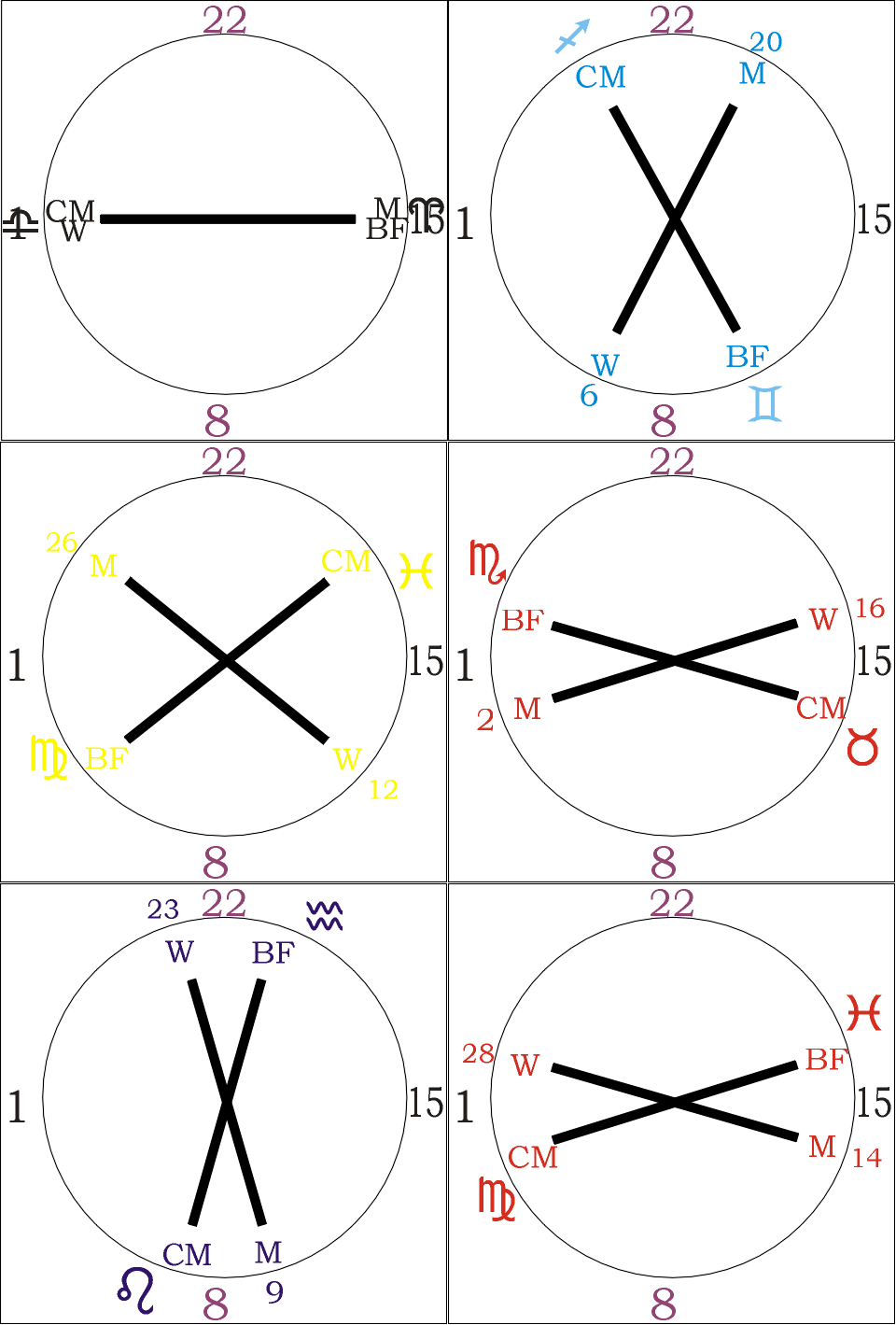
So the two sets of Faculties each follow their own direction: viewed on the Great Wheel, the lunar Faculties of Will and Mask move anti-clockwise forward through the phases, and the solar Faculties of Creative Mind and Body of Fate move clockwise backward through the phases, but forward through their own measure, the Zodiac. Here when Will is placed at Phase 15, Creative Mind is at its equivalent, in this case Aries, and as Will moves forwards through Phases 16, 17 and 18, Creative Mind is moving forwards in its own measure through the rest of Aries and into Taurus.
Even if we take Aries as East aligned with Phase 15 as South, exact alignment is problematic but generally the centre of Phase 15 is the start of Aries, its 0˚, and after that the question is whether a sign of the zodiac is a twelfth of the complete circle, as above, or whether the zodiac maps onto discrete groups of phases, making whole phases match whole signs, usually with the cardinal phases taking a whole sign each and the others in triads, as below.
In this arrangement the Zodiac starts with Aries at Phase 15 again, but against the triad of 14-13-12 comes the whole sign of Taurus, followed by all of Gemini alongside 11-10-9. If you follow a single Faculty in either of the animations you will see the lunar Faculties of Will and Mask proceeding anti-clockwise through the phases or the solar Faculties of Creative Mind and Body of Fate proceeding clockwise through the zodiac.

These, I'm afraid, are only the preliminaries to some speculations about various types of cycle that are not included in A Vision itself, and which I shall come to in further posts (and they do not even touch on the disposition of the zodiac in Edmund Dulac's woodcut of the Great Wheel, which I'll come back to yet another day). However, this aspect of zodiacs and phases running counter to one another does surface, albeit rather cryptically, in A Vision's discussion of the "heraldic supporters" of the Full Moon, which I'll examine next.
Twelve and the zodiac are, for Yeats, the sun's measures, while twenty-eight and the months are the moon's, so often Yeats uses the zodiac to emphasize a solar measure, opposed or contrasted to the moon's phases or months.

In Yeats's diagrams the phases of the moon always run anti-clockwise and for most purposes act as a foundation for the rest of the structure. If the sense of progression or order is following this basic pattern, then the zodiac follows the same direction. So if we seek to pattern the year after the phases, with Phase 15 in spring, Phase 22 in summer, Phase 1 in autumn and Phase 8 for winter, the months or zodiac will follow the same pattern, starting with March or Aries and proceeding anti-clockwise.
Other arrangements follow the cardinal directions of the compass, with Aries as solar East at Phase 22 (which is lunar East), Cancer as North at Phase 1 (lunar North), Libra as West at Phase 8 (lunar West), and Capricorn as South at Phase 15 (lunar South). (The solar symbolism is logical but mixes annual and daily elements: North and South are marked by the sun's tropical or turning points, its maximum northerly latitude coming at the Tropic of Cancer and its maximum southerly latitude at the Tropic of Capricorn; if Capricorn is at the daily midheaven in the South, then Aries is rising in the East and Libra is setting in the West.) This is the pattern used when dealing with the afterlife, when we are trying to stress the continuity with life, and the continuing process, the equivalents follow the order of the phases.
In the compass scheme solar East maps onto lunar East, but if we use the same terminology for the seasonal scheme we find that "Lunar South is Solar East" (AVB 198n), that is to say that Phase 15 (S) corresponds to Aries (E).

Yet in another sense, both of these zodiacs are lunar, since they both run anti-clockwise. It's worth remembering that in general anti-clockwise is the lunar direction, patterned on the moon's course across the sky over successive nights (it is even noticeable in the course of a single night if you are gazing at the stars for long enough). And clockwise, like the clock itself, follows the path of the Sun during the day when you are facing south (northern hemisphere). Yeats was alerted to this rationale after the publication of the first edition by Frank Pearce Sturm (FPS 90-91) and used it in the second version (see AVB 80), but in many ways it follows the old ideas of right and sunwise being favoured or lucky (deiseal in Irish, the basis of the Wiccan coinage deosil), while left and widdershins are "sinister" and associated with the nightside. When describing the motion around the circles, Yeats himself often uses the very unclear terms left to right for clockwise and right to left for anti-clockwise, imagining always movement "over the top" of a diagram, rather than under the bottom (and when he does, writing about sides of cones, he gets them mixed up, see AVB 76).
So the two sets of Faculties each follow their own direction: viewed on the Great Wheel, the lunar Faculties of Will and Mask move anti-clockwise forward through the phases, and the solar Faculties of Creative Mind and Body of Fate move clockwise backward through the phases, but forward through their own measure, the Zodiac. Here when Will is placed at Phase 15, Creative Mind is at its equivalent, in this case Aries, and as Will moves forwards through Phases 16, 17 and 18, Creative Mind is moving forwards in its own measure through the rest of Aries and into Taurus.

Even if we take Aries as East aligned with Phase 15 as South, exact alignment is problematic but generally the centre of Phase 15 is the start of Aries, its 0˚, and after that the question is whether a sign of the zodiac is a twelfth of the complete circle, as above, or whether the zodiac maps onto discrete groups of phases, making whole phases match whole signs, usually with the cardinal phases taking a whole sign each and the others in triads, as below.
In this arrangement the Zodiac starts with Aries at Phase 15 again, but against the triad of 14-13-12 comes the whole sign of Taurus, followed by all of Gemini alongside 11-10-9. If you follow a single Faculty in either of the animations you will see the lunar Faculties of Will and Mask proceeding anti-clockwise through the phases or the solar Faculties of Creative Mind and Body of Fate proceeding clockwise through the zodiac.
These, I'm afraid, are only the preliminaries to some speculations about various types of cycle that are not included in A Vision itself, and which I shall come to in further posts (and they do not even touch on the disposition of the zodiac in Edmund Dulac's woodcut of the Great Wheel, which I'll come back to yet another day). However, this aspect of zodiacs and phases running counter to one another does surface, albeit rather cryptically, in A Vision's discussion of the "heraldic supporters" of the Full Moon, which I'll examine next.
The lot of love is chosen. I learnt that much
Struggling for an image on the track
Of the whirling Zodiac.
"Chosen"
Monday, September 26, 2011
Dulac and the Great Wheel

The Great Wheel of A Vision A, printed on brown paper,
tipped into the book on [p. xiv].
tipped into the book on [p. xiv].
The Great Wheel that appears opposite p. xv in A Vision A is one of the enduring images that most readers retain of A Vision, an archaic woodcut that hints at symbolic meanings, some of which are never quite explored in the book itself. Yeats gave Edmund Dulac both guidance and latitude in his instructions for the design, trusting him as a personal friend, who shared many of his own esoteric interests, particularly astrology. He had already asked Dulac to make a picture of Giraldus, his putative author of Speculum Angelorum et Hominum in Cracow, and in thanking Dulac for the portrait he outlined his requirements for a diagram, supposedly from this Speculum, in October 1923:
My dear Dulac,
The portrait of Gyraldus is admirable. I enclose the sketch for the diagram. The pencilled words will have to be in Latin & I will get the Latin I hope tomorrow. The man I count on for it was out yesterday. You can use any symbolism you like for the elements—nymphs, salamanders, air spirits, or Roman gods or more natural objects.…
The round objects in the enclosed diagram are of course the lunar phases 1. 8. 15. 22 making new moon, half moon, full moon & half moon respectively. They will be nasty things to draw but your Kracow artist would not have drawn them very carefully. I can give the Speculum what date you please.…
(October 14, [1923]; cf. Letters 699–700)
- (1) Yeats's sketch must have indicated the placing of the elements, whether by word or symbol and, though he may have hoped for something a little more exuberant and elaborate, Dulac uses just the simple symbols for the four elements, placed on furled banners.

The kind of picture Yeats was originally thinking of?
Note the elemental corners, which have the same arrangement as that of A Vision. These surround a ring depicting sun and moon formed by two intersecting circles, one dark and one light.
Frontispiece of Musaeum Hermeticum (Frankfurt, 1625).
Frontispiece of Musaeum Hermeticum (Frankfurt, 1625).
- (2) The "round objects" might not have been entirely self-explanatory, except that Dulac had no doubt been told about the 28 phases of the moon—everybody else seems to have been—so Yeats could therefore comment that they were "of course the lunar phases 1. 8. 15. 22" (I am using John Kelly's transcription, rather than Wade's; the other letters are drawn from Diana Hobby's unpublished thesis, "William Butler Yeats and Edmund Dulac, a Correspondence: 1916–1938" [Rice University, 1981]).
- (3) The zodiac signs are not mentioned but were almost certainly in the diagram as they were in most iterations of the schema in the notes and drafts, though Yeats was still unclear about their significance and later had doubts about their placing.

The kind of picture Yeats was originally thinking of?
Classical figures symbolize the elements on either side of the title (clockwise from upper left: Jupiter - Air; Prometheus – Fire; River god [?Nile] – Water; [?]Autumnus – Earth).
Above, Phoenix and Minerva, on the left, and Pelican and Mercury, on the right, flank Apollo with the Nine Muses. Below, the sun, with a lion (Leo), and the moon, with a crayfish (Cancer), flank an emblem of Nature, holding the light of perfection, followed by short-sighted researchers with lanterns.
Engraved title page of Musaeum Hermeticum revised (Frankfurt, 1678), by Matthäus Merian.
Classical figures symbolize the elements on either side of the title (clockwise from upper left: Jupiter - Air; Prometheus – Fire; River god [?Nile] – Water; [?]Autumnus – Earth).
Above, Phoenix and Minerva, on the left, and Pelican and Mercury, on the right, flank Apollo with the Nine Muses. Below, the sun, with a lion (Leo), and the moon, with a crayfish (Cancer), flank an emblem of Nature, holding the light of perfection, followed by short-sighted researchers with lanterns.
Engraved title page of Musaeum Hermeticum revised (Frankfurt, 1678), by Matthäus Merian.
- (4) The "pencilled words" must have been the English—Beauty (15), Wisdom (1), Temptation (8) and, probably, Power (22)—and a little over a week later Yeats sent on the Latin that he had been given by Louis C. Purser, a distinguished classicist at Trinity College, Dublin: "put Pulchritudo at 15, Sapientia at 1, Tentatio at 8 and Dominatio (or Potestas) at 22. I enclose Purser's letter as his spelling may correct mine" (October 23, [1923]). There are two points of variance from the words Yeats gives, the minor one of "Temptatio" and the major one of "Violentia" rather than "Dominatio". The first may reflect Purser's spelling or Dulac's preference to avoid a spelling that looked more like his native French. "Violentia" is stranger and less readily explicable, but there was plenty of time for Yeats to modify his ideas, since it was over a year and a half before Dulac sent the design to him (see below).

The kind of picture Yeats was originally thinking of?
The four elements are symbolized by animals and the four humours by goddesses: (clockwise from top left) Diana/Artemis – Phlegm, corresponding to Water – Dolphin; Venus/Aphrodite – Blood corresponding to Air – Chameleon; Minerva/Athene – Yellow Bile corresponding to Fire – Salamander; [?]Ceres/Demeter – Black Bile corresponding to Earth – Mole. Septem Planetae, engraved title page by Gerard de Jode (after Maarten de Vos), 1581.
The four elements are symbolized by animals and the four humours by goddesses: (clockwise from top left) Diana/Artemis – Phlegm, corresponding to Water – Dolphin; Venus/Aphrodite – Blood corresponding to Air – Chameleon; Minerva/Athene – Yellow Bile corresponding to Fire – Salamander; [?]Ceres/Demeter – Black Bile corresponding to Earth – Mole. Septem Planetae, engraved title page by Gerard de Jode (after Maarten de Vos), 1581.
- (5) The emblems at the centre of the diagram seem to have been Dulac's own idea. Yeats had sent him a draft of the introductory material when he requested the portrait of Giraldus—"I send you my preface, in the rough, or rather Owen Aherne's. It will give you all the facts as I see them" (July 26, [1923]). This typescript spoke of a design where "the zodiacal signs were arranged in a circle with a unicorn in the center, while in the corners of the diagram <cancelled words> Biblical symbols", which Dulac seems to have realized only rather late in the day:
Herewith the Diagram. When it was done I remembered in that your description of it you mention that the square in the center is occupied by a design of a unicorn. Thence the accompanying design of the Animal in question. If it is not absolutely necessary that the Diagram should incorporate it leave it as it is, but if its presence in the Diagram is of vital importance, the engraver can make the two blocks and fit that of the Unicorn in its proper place for the purposes of printing. Otherwise it may be used as a tail piece somewhere else in the book. (April 30, 1925; LTWBY2 462)
The animal in question did indeed appear as a tail piece to the poem, "The Phases of the Moon", pasted in at the end.

If the designs were, however, Dulac's idea, Yeats was happy to incorporate them—"The designs are exactly right. 'The Wheel' could take in the whole British Museum" (May 5, [1925]). He changed the introduction so that the "lunar phases and zodiacal signs were mixed with various unintelligible symbols—an apple, an acorn, a cup" (AVA xviii), and later noted that "The East, in my symbolism … is always human power" adding as explanation that "In the decorative diagram from the Speculum Angelorum et Hominum … the East is marked by a sceptre" (AVB 257–58).
As this indicates, the emblems do logically express the words Yeats had given, at least to some extent: Beauty – a flower, plausibly; Wisdom – a fruit, possibly; Temptation – a cup, possibly too; Power – a sceptre, certainly. But they also show kinship with traditional playing card suits. Though the English-speaking world tends to use the suits of French origin—spades, hearts, diamonds and clubs—the rest of Europe draws on similar but different symbols.


Swiss suits; three variants of German suits; three variants of North Italian suits
from "Andy's Playing Cards", with thanks to Andrea Pollett.

from "Andy's Playing Cards", with thanks to Andrea Pollett.
Dulac's flower has definite similarities with the Swiss one, while the fruit seems to have the idea of the acorn mixed with the shape of the bell from Swiss and German iconography and may explain why Yeats refers to an acorn AND and an apple. The cup and sceptre are more clearly linked with the traditional Italian suits—denari, coppe, spade, bastoni—emblems which are also retained in the Tarot cards. Certainly this was in keeping with Yeats's own thought and the early drafts of the Arabian fictions outlined in A Vision A, indicate that "the four suits of the Tarot, the King, the Queen, the Knight & the Knaves should really be King, Queen, Prince & Princes, & were derived through the Saracens from the dance, & … these cards have in turn given birth to our common court cards" (YVP4 153).
In the end, however, what kind of picture was Yeats originally thinking of? He was willing to shift the date from the late sixteenth century to earlier, but he does seem to have conceived of a later, slightly more refined style than he was finally given by Dulac, although the style was clear and agreed on once he had the portrait of Giraldus. Of the illustrations above, one is before the date of 1594 that he gave and the other is other is after it, but both are rather more elaborate than the style that Dulac created. At that date, the woodblock style is more generally used for illustrations inserted into the text, while the finer lines and greater detail of engraving are used for full-page illustrations. It seems possible that Yeats had originally conceived of a more clearly sixteenth-century look, and also that the design would centre on a unicorn—symbol of the Daimon, or of the soul. Might he have been thinking of something more like this?

Thursday, August 11, 2011
The Square Wheel and Chessboards
It shouldn’t be surprising that the Great Wheel of A Vision has some characteristics that seem to fit rather well with a square format rather than the more familiar circular one.
When W. B. Yeats drew up a quick chart of the heavens, either for a person’s horoscope or to cast a horary chart, he usually used the traditional square horoscope, which he’d probably learnt from his astrological uncle, George Pollexfen. (I remember reading some years ago that Cyril Fagan, a distinguished Irish astrologer, had commented that Yeats was one of the last to use this old-fashioned format, and I was very dubious. I later saw the evidence of it for myself throughout his notebooks but now have no idea where that reference was, despite some desultory searching.*[now found, see end])

The first and most obvious one is that a standard chessboard, with eight squares on each side, has a perimeter of twenty-eight squares. Yeats actually states that "the individual phases are alternately primary and antithetical" (AVB 88), and here we have the alternating squares of black and white (and, as with Yeats’s comment, this does lead to the slightly odd situation of Phases 1 and 15 being the same).
It’s probably best to put the square on point, so that it can be seen in the same orientation as normal presentation of the Wheel in A Vision.

The second feature, that is probably the most interesting in some respects, although one which the Yeatses themselves don’t seem to have used, is the way that the square format helps the mapping of the twenty-eight phases onto the twelve months or signs of the Zodiac.
When a circle is mapped onto a larger circle, the divisions scale up naturally, but when a square is mapped onto a larger square the sides transfer automatically but new squares appear at the corners, as the corner squares map on to each side and the new corner square. It makes more sense when you see it.
While 28 does not map easily onto to 12, if you place another row of squares along each side of the chessboard so that it is ten squares on each side, it has a perimeter of 36 squares, easily mapped onto a twelvefold scheme, with three squares for each twelfth. The division of the months into three periods of roughly ten days each may seem a little arbitrary, though it has good calendrical precedent as far back as ancient Egypt.

The diagram here takes the correspondences sketched out in "The Completed Symbol", Section VI, with March aligned with the Full Moon and September aligned with the New Moon and both phases and calendar proceeding anti-clockwise. Whereas Yeats comments "There is no reason why March, June, etc., should have one Phase, all others three; it is classification not symbolism" (AVB 196), here it is simply logical that the corner or cardinal phases should have a month or sign apiece.
It is also worth remembering that the Zodiac has long been divided into 36 decanates, divisions of 10˚ each, so that each sign has three sectors.
The correspondences here are those sketched out applied to the Zodiac rather than the months, so with Aries aligned with the Full Moon and Libra aligned with the New Moon, though Yeats actually places "the Ides of March, at the full moon in March" with "the Vernal Equinox, symbolical of the first degree of Aries, the first day of our symbolical or ideal year", so we'll need to look at the fine tuning beyond the broad principle shortly.
While we are about it, it is also worth considering that the central space is made up of four squares, surrounded by twelve squares, then twenty and then twenty-eight. The four and the twelve have relatively obvious applications (the inner Zodiac here is the one that corresponds with the phases during the afterlife, see AVB 223).

click on any of the images for a larger, more legible version
When W. B. Yeats drew up a quick chart of the heavens, either for a person’s horoscope or to cast a horary chart, he usually used the traditional square horoscope, which he’d probably learnt from his astrological uncle, George Pollexfen. (I remember reading some years ago that Cyril Fagan, a distinguished Irish astrologer, had commented that Yeats was one of the last to use this old-fashioned format, and I was very dubious. I later saw the evidence of it for myself throughout his notebooks but now have no idea where that reference was, despite some desultory searching.*[now found, see end])


Certainly his wife, George, from a younger generation—and probably more accustomed to using printed blanks—always used a circular layout. And that is the layout that dominates throughout the automatic script. Even when the spirits were taking control, their scrawls are almost always based on circular forms.
Yet certain features of the system lend themselves readily to a square format. For now I’ll limit myself to the two most fundamental and practical.

The first and most obvious one is that a standard chessboard, with eight squares on each side, has a perimeter of twenty-eight squares. Yeats actually states that "the individual phases are alternately primary and antithetical" (AVB 88), and here we have the alternating squares of black and white (and, as with Yeats’s comment, this does lead to the slightly odd situation of Phases 1 and 15 being the same).
It’s probably best to put the square on point, so that it can be seen in the same orientation as normal presentation of the Wheel in A Vision.

The second feature, that is probably the most interesting in some respects, although one which the Yeatses themselves don’t seem to have used, is the way that the square format helps the mapping of the twenty-eight phases onto the twelve months or signs of the Zodiac.

When a circle is mapped onto a larger circle, the divisions scale up naturally, but when a square is mapped onto a larger square the sides transfer automatically but new squares appear at the corners, as the corner squares map on to each side and the new corner square. It makes more sense when you see it.
While 28 does not map easily onto to 12, if you place another row of squares along each side of the chessboard so that it is ten squares on each side, it has a perimeter of 36 squares, easily mapped onto a twelvefold scheme, with three squares for each twelfth. The division of the months into three periods of roughly ten days each may seem a little arbitrary, though it has good calendrical precedent as far back as ancient Egypt.

The diagram here takes the correspondences sketched out in "The Completed Symbol", Section VI, with March aligned with the Full Moon and September aligned with the New Moon and both phases and calendar proceeding anti-clockwise. Whereas Yeats comments "There is no reason why March, June, etc., should have one Phase, all others three; it is classification not symbolism" (AVB 196), here it is simply logical that the corner or cardinal phases should have a month or sign apiece.

It is also worth remembering that the Zodiac has long been divided into 36 decanates, divisions of 10˚ each, so that each sign has three sectors.


The correspondences here are those sketched out applied to the Zodiac rather than the months, so with Aries aligned with the Full Moon and Libra aligned with the New Moon, though Yeats actually places "the Ides of March, at the full moon in March" with "the Vernal Equinox, symbolical of the first degree of Aries, the first day of our symbolical or ideal year", so we'll need to look at the fine tuning beyond the broad principle shortly.
While we are about it, it is also worth considering that the central space is made up of four squares, surrounded by twelve squares, then twenty and then twenty-eight. The four and the twelve have relatively obvious applications (the inner Zodiac here is the one that corresponds with the phases during the afterlife, see AVB 223).

click on any of the images for a larger, more legible version
We'll come back to these boards again soon, since there are dimensions that touch on chess, both regular and Enochian, tarot and the I Ching, all of which are worth exploring in greater depth.
————————————————————————————
*Update: 3 August 2022. The reference appears in Fagan's "The Origin of Horoscope Form", 12/61 American Astrology:
Before beginning a delineation of an astrological chart we must fully comprehend the meaning of the horoscope form itself and its interpretation. The circular diagram is popular in the west today; but strange to say, it is a comparative innovation, notwithstanding the fact that the dome of the heavens is obviously circular. Up to the 19th century the square of rectangular shaped horoscope form was the vogue, as it is still the vogue in India. In his letters to the present writer, the Irish poet, W.B. Yeats, the Nobel prize winner for literature (1923), always used the square-shaped horoscope form. Why did the square-shaped form persist for so many centuries before it was gradually supplanted by the circular design, and how did it originate? The glib answer is, of course, that it was easier to draw. But is that the only reason?
Cyril Fagan, Heliacal Phenomena, page 19
Monday, August 8, 2011
The start of a gyre. . .

This blog is intended as a companion to my website about A Vision, YeatsVision.com, and both examine the esoteric system created by William Butler Yeats and his wife, George Hyde Lees. Whereas the website aims to offer clear and direct interpretation of A Vision for readers and students, confining itself largely to what Yeats himself wrote and to the academic study of his work, the comments and articles here will be rather more speculative, exploratory and possibly personal. I also hope that as and when people arrive they will feel able to enter into some dialogue about topics through the comments.
I will be adding to the blog very slowly, but since it is far from topical and will only be minimally sequential, I hope that readers will feel able and welcome to respond to any post, whether it was nominally put up the day before or months or even years before—this kind of web dialogue can be both instant and leisurely. Like Yeats, I recognize that most of the material here will not be of great general interest and is for the relatively small group of “my fellow students” of A Vision, but I know myself from the way that a search-engine or a link leads to unexpected places, there will be some people who stumble onto this without knowing much about what’s going on. If you are in doubt or are intrigued, do go and look at YeatsVision.com (especially Overview) for simpler and more straightforward explanation of the material.
Subscribe to:
Posts (Atom)